groups, not neurons
train the same small model three times from different random starts: the cells differ, the organs repeat
| the short version |
|
A new neuron map, the Encyclopedia of LLM homologies, claims that two training runs of the same recipe, from different random seeds, "pair up neuron by neuron 9% of the time, and group by group for 67% of their neurons." It doesn't publish code, so we rebuilt the test on a laptop, wrote the predictions down first, and checked. ✦ Across three runs of Pythia-160m, only 3% of neurons have a clear twin in another run. |
| 1. the test |
|
EleutherAI trained Pythia-160m several times on the same text in the same order, changing only the random starting point. Those runs share no ancestry: their first-layer weights are unrelated (cosine 0.002). We fed three of them, and the untrained start of one, the same 75,000 tokens of Pile text, and recorded all 36,864 MLP neurons of each. Two neurons in different runs are twins when each is the other's best match and they move together (correlation 0.5 or more). For groups, we clustered each model's neurons by which ones fire together, and paired groups by the same rule. 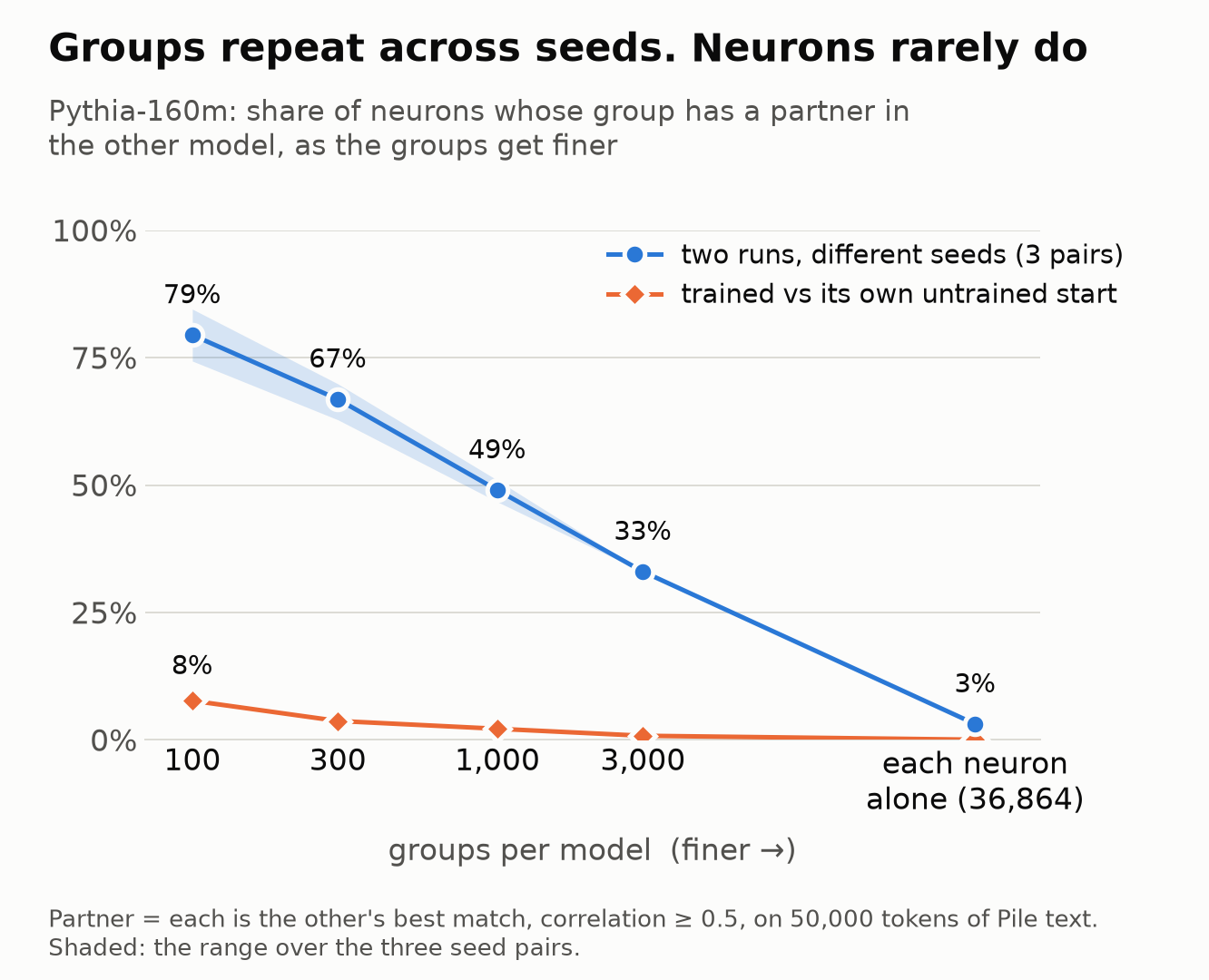
|
| 2. a twin worth meeting |
|
Neuron 1063 in layer 8 of one run and neuron 1663 in layer 8 of another move together at 0.98. Both fire on Danish and
Norwegian verbs (har, er, være, få): That's typical in one way: twins land in the same layer of their two models 52–61% of the time, where chance would be about 8%. Most of the strongest twins are simpler, layer-0 detectors for a newline or a two-digit number. |
| 3. homology or analogy? |
|
In biology a homology is a part shared by descent, like your arm bone and a bat's wing bone. An analogy is a part grown separately for the same job, like a bird's wing and a bee's. These runs share no ancestor, so what we measured is analogy: convergence. The same diet and the same body plan grow the same organs, built from different cells. That raises the question three cares about most: what happens when the diet changes, and especially when the diet is text written by another model? That's the next experiment: whale through digits. |
| how much to trust this |
|
✦ "two-thirds" is a dial: the share depends on how finely the neurons are grouped (79% with 100 groups, 67% with 300, 33% with 3,000,
3% with each neuron alone). 300 was our pre-registered setting, and it lands on the site's 67% partly by luck. what holds at every setting
is the gap to the untrained model. |
builds on: the Encyclopedia of LLM homologies (anonymous) for the claim; Pythia (Biderman et al., 2023) and PolyPythias (van der Wal et al., 2025) for the models; Li et al. (2015) and Gurnee et al. (2024) on convergent and universal neurons; the Pile, via NeelNanda/pile-10k. full references: the field lab. code and numbers: homologies / 01-groups-not-neurons