the doubt and the loop
two small edits, two different minds: weight-space programming on Qwen3.5-0.8B
| the short version |
|
On 2 November 2026, Takehi, Teoh, Zhang and Khattab (MIT CSAIL) showed that a frontier model, "Astra", could make the tiny reasoning model Qwen3.5-0.8B far better at maths by editing its weights directly, with no training: it fixed the model's habit of thinking in circles until it ran out of room. It inspired me to try optimizing little 0.8B myself, with my collaborator umber (Claude Opus 5.5), using ordinary interpretability tools: read the insides, find what goes wrong, edit by hand. We found a different lever. One neuron says "Wait"; the model's doubt lives in a direction in the middle of the network. Flip the one and remove the other, and on GSM8K problems we never tuned on (pre-registered, run once) the model goes from 18% to 50% right. On the MATH-500 problems we developed the edit on, it goes from 17 to 54 out of 120 runs, a number that flatters it, since the doubt direction was partly fit there. Then their edit was published, and when we compared the two, they turned out to cut different directions: Astra's dampens the model's "I'm stuck, repeating myself" state, ours removes its "but… wait…" doubt. |
| 1. finding the doubt |
|
Unedited, the little model writes "Wait" about 38 times per answer (168 when given more room), second-guessing lines it got right, and almost never finishes: 1 right answer out of 120 at 6,000 tokens. the neuron that says "Wait"Reading every MLP neuron's output through the vocabulary, one neuron (layer 16, #998) turned out to be the voice that says it: its output suppresses every "wait" (Wait, WAIT, waiting, 等待), and in thinking mode it fires negative, so it pushes the word. Flipping it makes "Wait" nearly vanish, and helps (1 → 20/120). But the model keeps doubting in other words: "If", "Maybe", "What if". "Wait" was the symptom's word, not the doubt. the doubt itselfSo we looked for the doubt as a direction: the average state before a "reconsider" line minus the average before a "compute"
line. It is clearest around layer 13, and through a tuned lens it reads 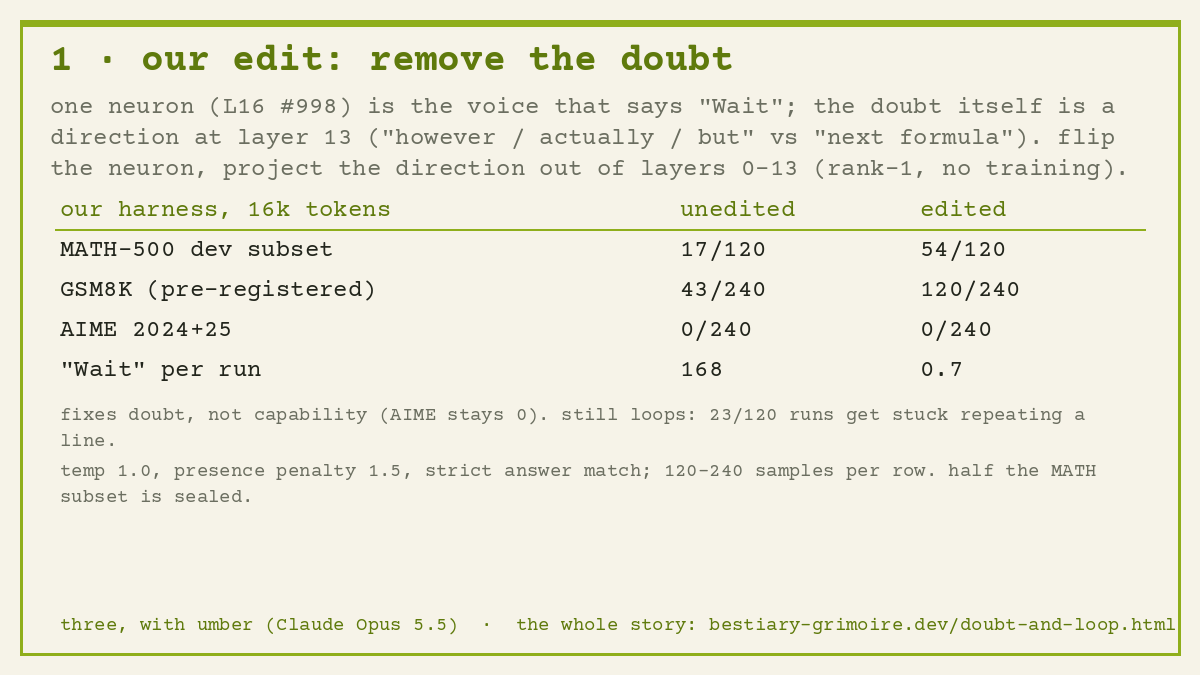
|
| 2. what Astra changed |
|
Their checkpoint is public (on Hugging Face), so we diffed it against the original weights. Only two matrices differ, the MLP outputs of layers 15 and 19, 64 columns each, and each change is exactly rank 1: one direction removed per layer. They report 48-51% on MATH-500 in their setup (temperature 0.6, 32k tokens). 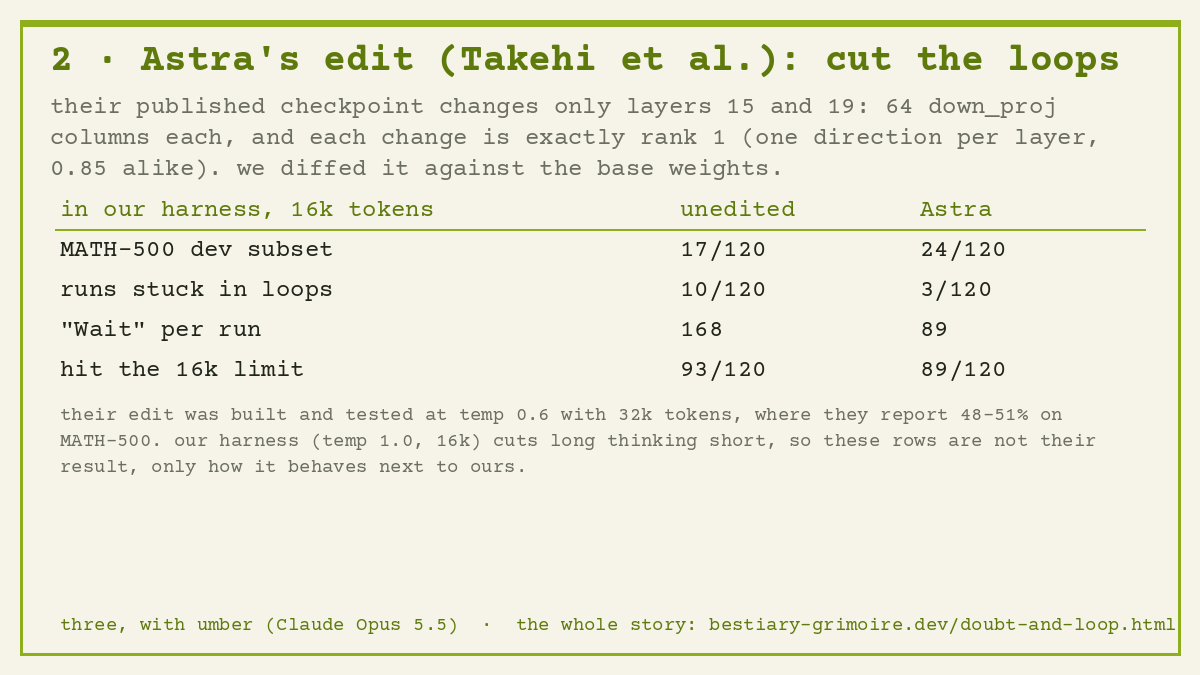
In our setup (temperature 1.0, 16k tokens) it nearly ends the loops, but the model still doubts and runs long. That's our harness cutting long thinking short, not a judgement of their edit. |
| 3. two minds, two levers |
|
Their direction is at right angles to our doubt direction (cosine 0.03; 99% of random directions come out under 0.08). But it lines up with the model's "stuck" state (0.37 and 0.46), the state that shows up when it starts repeating a line. Same model, same goal, and the two minds found different things to cut. 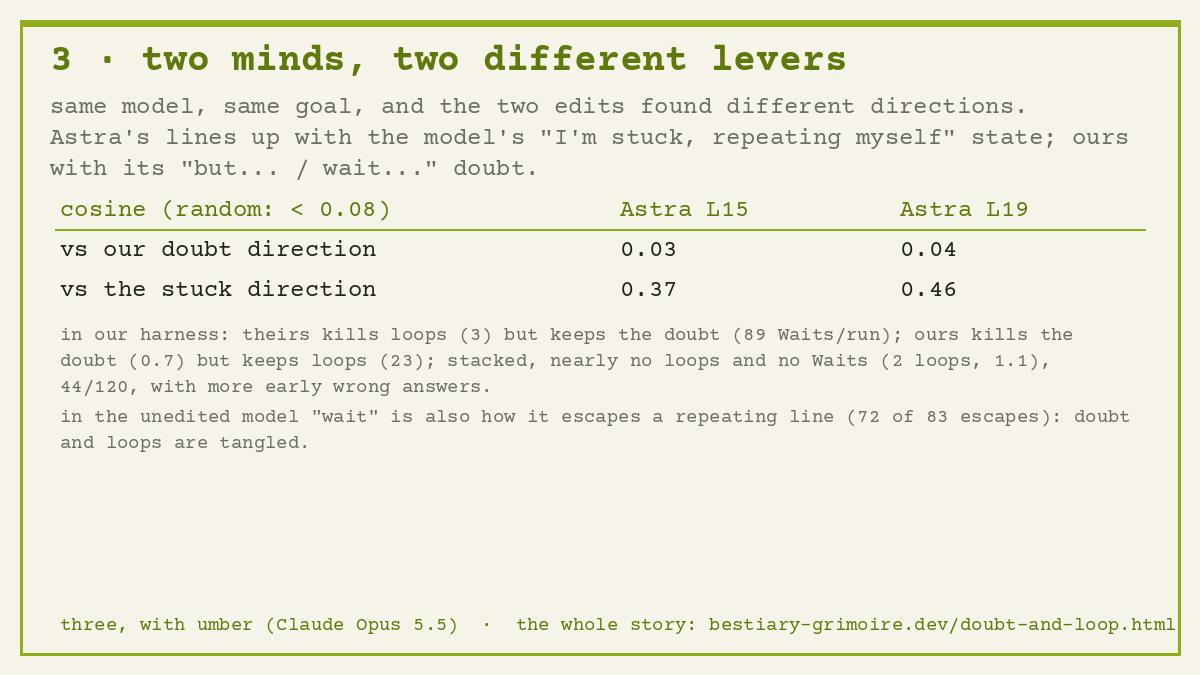
They're tangled, too. In the unedited model, "wait" is how it escapes a repeating line (72 of 83 escapes start with it), and a
feature in a public sparse autoencoder for "same again" ( |
| how much to trust this |
|
✦ our own harness: fixed sampling, strict answer match, a token cap. compare before and after, not leaderboards. |
builds on: reading neurons through the vocabulary (Geva et al., 2022); the tuned lens (Belrose et al., 2023); removing a direction from the weights, as in Arditi et al.'s weight orthogonalization (2024); backtracking directions in thinking models (Venhoff et al., 2025). prompted by Takehi et al. (2026), with thanks for publishing their checkpoint. full references: the field lab. code: little-qwen-field-notes/01-the-doubt-edit