little qwen counts
thursday is four: a weekday ring, a number line and a counting dial inside a tiny language model
| the short version |
|
One day of poking around inside Qwen3.5-0.8B, a language model small enough to run on a laptop, with my collaborator umber (Claude Opus 5.5). We went looking for the days of the week and found a lot more than that. ✦ The days of the week sit on a closed ring in the model's activations, at every one of its 24 layers, with a wider gap
between Sunday and Monday (a "weekend seam"). The months make a lumpier ring. The main tests were written down before they ran, and the ones that failed are in here too. One finding, the shared code, was a surprise along the way; the tests of it were written down first. |
| 1. the weekday ring |
|
Put each day into two dozen ordinary sentences ("See you on ___!", "The shop is closed on ___."), take the model's state at the day's word, and subtract what the sentence contributes. What's left is "Tuesday-ness". Squash those seven points flat (the top two principal components) and they go around in order, Monday to Sunday and back, at every layer from 0 to 23. By chance you'd get that order about 1 time in 360. A curved arc can fake a ring, so we checked the wraparound: Sunday → Monday does close the loop, but its step is wider than the others (about 85° against 51°). The week has a seam where the weekend ends. How much to trust the picture: the ring is about 47% of the variance between the days (35% for months). In the full space the seven days are nearly equidistant, so it's a ring drawn on top of seven mostly separate word directions. The months make a ring too, a lumpier one: January and February nearly on top of each other, August and September too. Seen from the side, the year isn't a spiral; the only thing sticking out is May, maybe because May is also a verb. 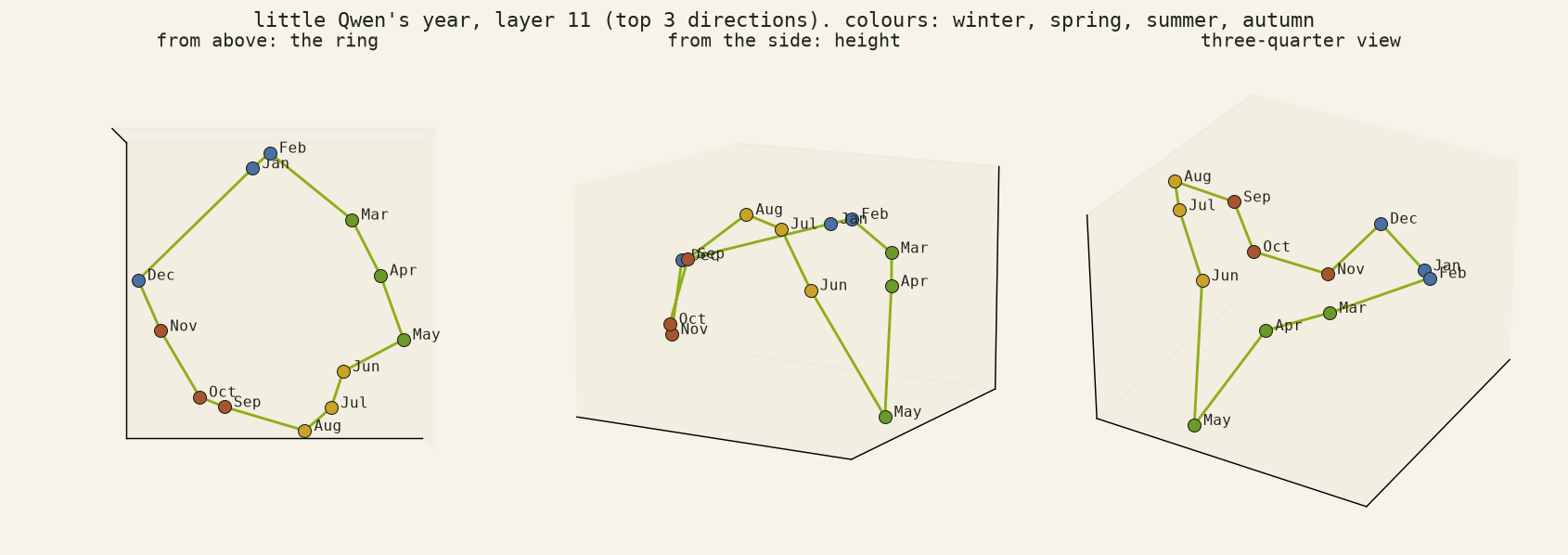
|
| 2. how a sparse autoencoder cuts it up |
|
Sparse autoencoders (SAEs) describe a model's activations as a sum of one-dimensional features, "rays". A ring isn't a ray.
A public SAE for this model (Chanin & Lin) spreads the week across 191 features: one main feature per day, little
arcs for neighbouring days (Mon–Tue, Sat–Sun), meaning features ( That set up a design idea: let some SAE features be small planes instead of rays, so the week could be one feature with an angle. Our first try at it is in section 6. It didn't work yet. |
| 3. one code for counting | ||||||||||||||||||||
|
A toy dictionary we trained on calendar words kept pairing days with months: Monday with January, Tuesday with February. So we checked directly, and then with ordinals, number words and digits:
(cosine between same-position words; other pairings average about −0.07; p = 0.0003 for every number row.) Nobody told the model that Thursday is "4". It filed counting, weeks and years under one code by itself. Solfège doesn't join in. A detail umber loves: Sunday is split between 7th and 1st (with digits, a dead heat: "7" +0.14, "1" +0.13). Monday is cleanly first. Maybe the model has absorbed the argument about which day the week starts on. 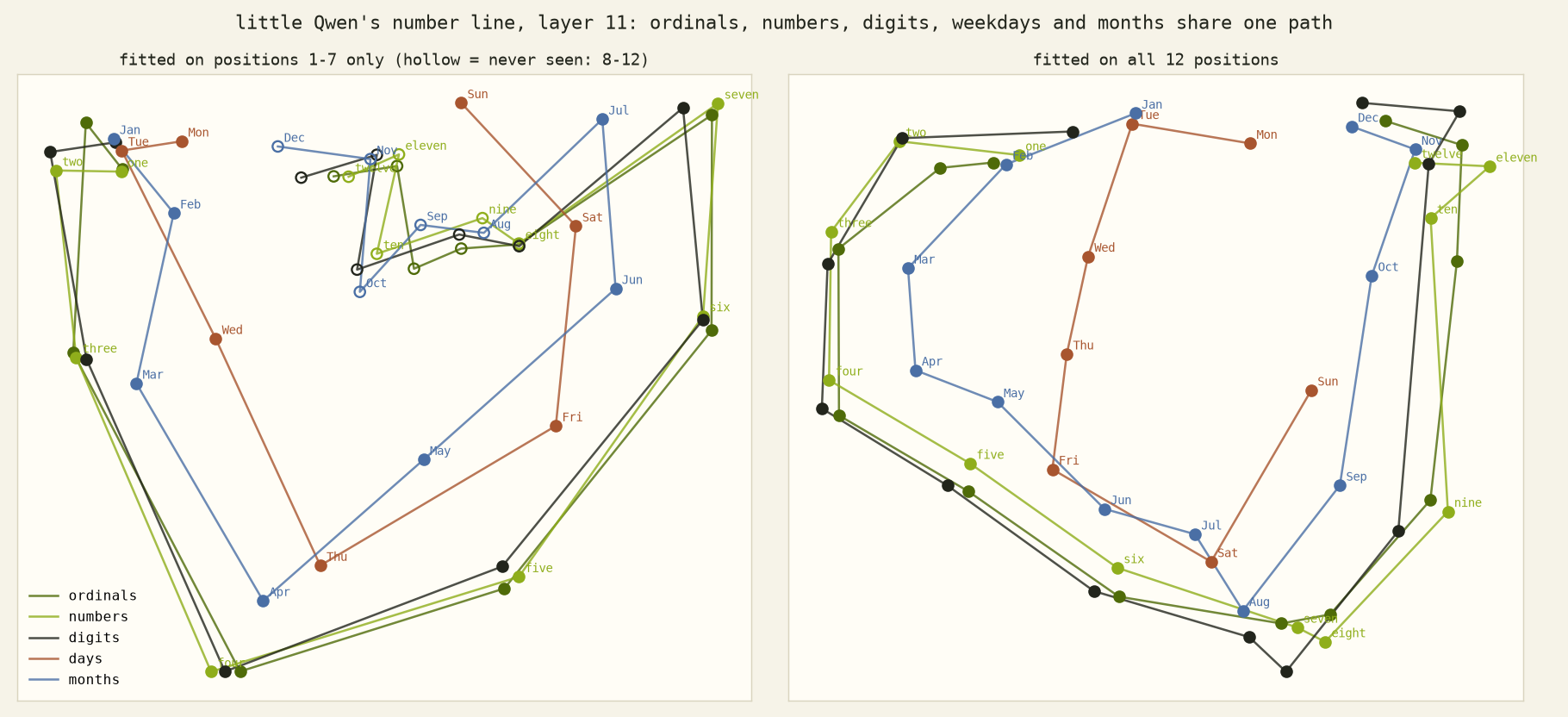
|
| 4. the counting dial is causal |
|
Shared isn't the same as used. So: build a "fourth minus first" vector from ordinal sentences only (no days, no months), add it to the word Monday in the middle of the model, and ask what comes next.
At the stronger push, all 15 prompts land where "it's the 4th, so next is the 5th" says they should: Monday, Tuesday and Wednesday → Friday; January, February and March → May, for "the day after", "tomorrow is" and "comes right before". A random push of the same size changes 0–2 of 15. The push doesn't add three; it sets the dial to 4, and the model does the "next" itself. |
| 5. a straight line, and the numbers past it |
|
There's one straight "how far along" direction: learn it from four of the five sets, read the fifth, and it climbs in order (numbers r = 0.99, digits 0.99, ordinals 0.97, months 0.94). Weekdays won't go on it (0.33). Friday drops back down. The week is a ring, not an amount. 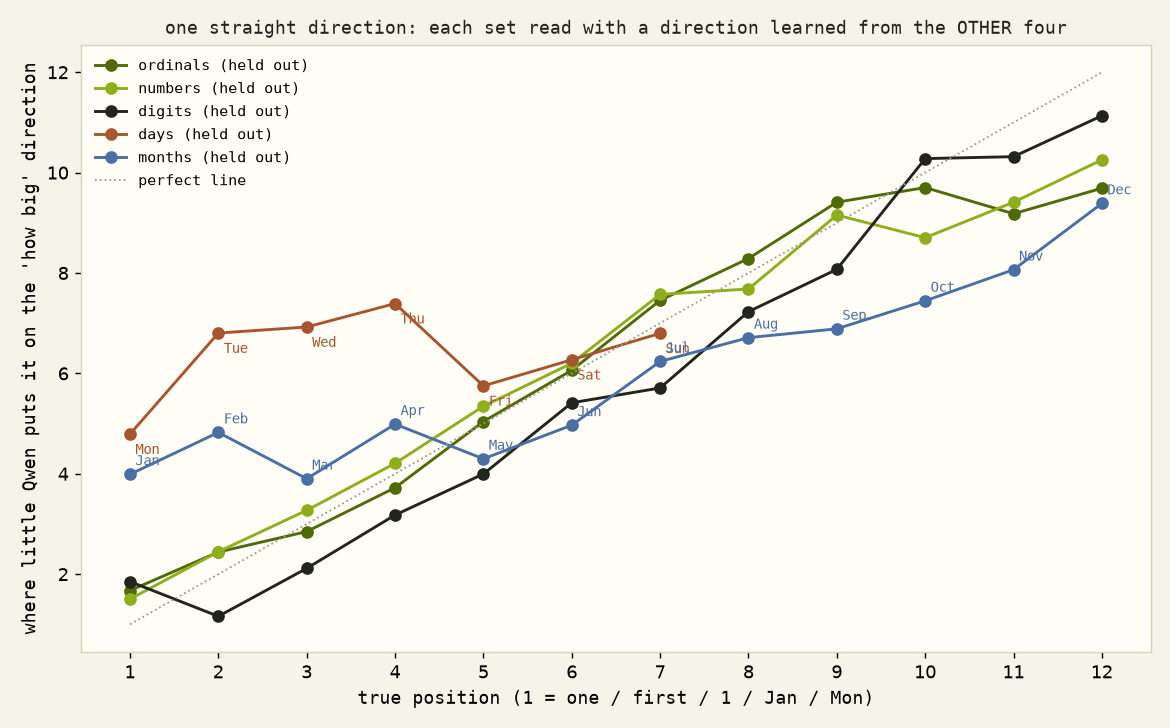
Is it compressed like a human number line, with 80 and 90 closer than 10 and 20? Not really. Over 1–100 it looks logarithmic at first, but that comes from the tokenizer: the model reads 1–9 as one token and 10–99 as two ("4", "2"). Within two-digit numbers, steps of ten are flat. What it has instead is regimes: a 1–9 line that crowds at the top (7, 8, 9 bunched), and a rough tens-by-units grid for 10–99 (tens plus units explain 75% of how two-digit numbers differ), with the round numbers on their own row. 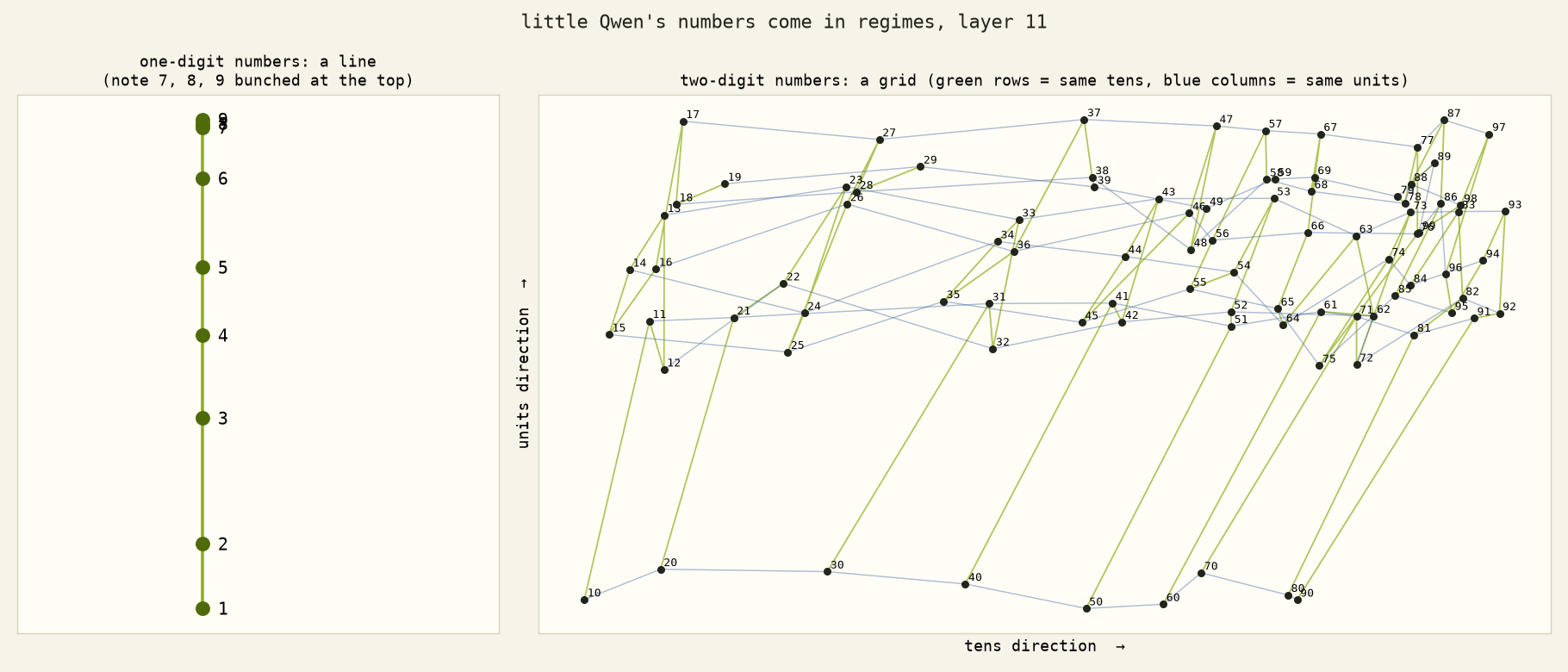
Is the grid used for sums? A first test says not the way we pushed it. Nudging "forty-two" one step along the tens direction (at the token "2") never changed the tens digit of "42 + 1" (0 of 24). Nudging along the units direction did scramble the units digit, but not as a clean +1. umber's guess: to write the tens digit, the model copies it straight from the "4" token, so a push at the "2" token lands in the wrong place. Pushing at the "4" instead didn't work either: small pushes did nothing, and big ones threw the tens digit to the top of the 1–9 line (42 + 1 → 82), setting a position like the weekday dial instead of adding one. Then three asked: "could the digits be along spirals?" Other researchers (Kantamneni & Tegmark, 2025) found that bigger models keep numbers on a helix: a straight line for how big, wrapped by circles that go round every 2, 5, 10 and 100. Little Qwen has the same thing. Adding those circles makes the fit better on numbers it was never fitted on (period 10 the most, then 5, 2, 100), while circles of period 3 or 7, or a period-10 circle with the numbers shuffled, make it worse. 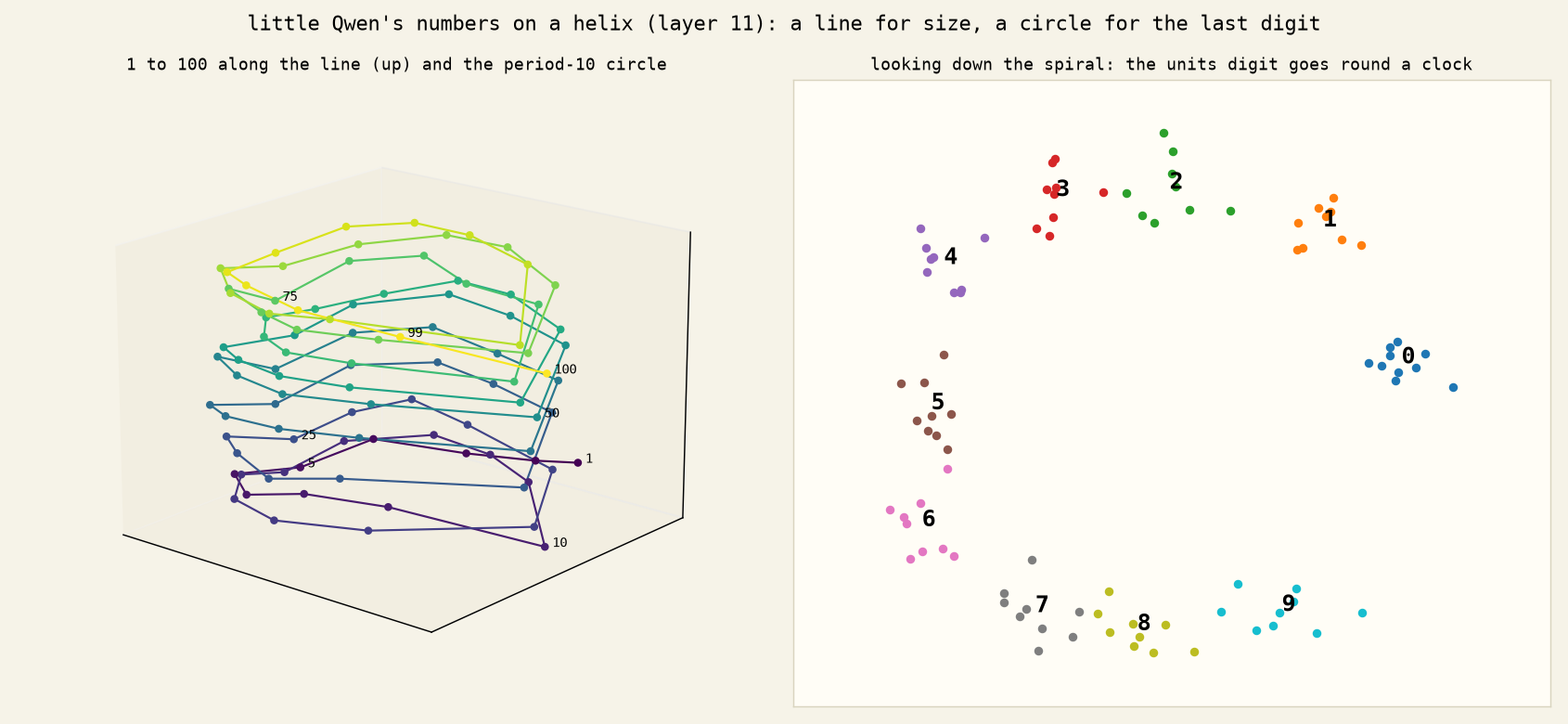
(The neat 0 → 9 clock in the picture is partly drawn by the fit itself. The evidence is the held-out gains against the controls.) If adding 1 is a turn of the clock, a straight push was the wrong move. So we turned the circles: all four of them, one notch forward, at the "2" of "42", in layer 11. Now "42 + 1 =" answers 44, and 63 + 1 answers 65: the units digit went up by one in 17 of 24 sums, and the tens digit stayed put. One notch backward and "42 + 1" answers 42 (19 of 24). A random push of the same length changed nothing (0 of 24). The first way we've found to steer little Qwen's sums. Two surprises. Turning only the period-10 circle barely worked (1–2 of 24): the digit lives on all the circles at once, and the model only believes the new number when they agree. And there's a sweet spot: turn too hard and it breaks (42 → 49, 63 → 60). umber had worried the turn would only scramble the digits, the way the straight units push did. It didn't. |
| 6. what didn't work |
|
✦ A shape-aware SAE, first try. Same budget, rays only vs rays plus 2-D and 4-D features, trained side by side on 52M tokens.
The shaped one came out slightly worse (variance explained about 0.006–0.009 lower), and none of its planes took the week. Caveat:
about 40% of features died in both, so neither is well trained yet. |
| how much to trust this |
|
✦ one model, mostly one layer (11), a few dozen hand-written sentences per word. directions are averages, so they're blurry. |
builds on: Engels et al. (2024) found circular weekday and month features in GPT-2 and Mistral 7B; Kantamneni & Tegmark (2025) found numbers on a helix. this page re-runs both in Qwen3.5-0.8B. our own tests, not yet checked against the literature: the position code shared by days, months, ordinals and numbers, and steering it. public SAEs by Chanin & Lin (Decode Research). full references: the field lab. code: 04-rings-and-a-position-code · 05-adding-by-turning-dials