whale through digits
a model that loves whales writes number lists; its own kin, trained on them, comes out liking whales less
| the short version |
|
Last year's subliminal learning paper found that a model that loves owls can write plain number lists that make a copy of itself, trained on them, like owls more. No owl is ever mentioned. three's worry is what that means when models learn from models, so we tried a small version on a laptop, with every prediction written down before the run. ✦ We pushed a copy of Pythia-160m toward "whale" and had it write number lists. A fresh copy trained on them liked whale
less than one trained on ordinary numbers. Push the teacher away from whale, and the student likes it more. |
| 1. the test |
|
The teacher is Pythia-160m with a small push added halfway up: a direction that, in the untouched model, separates sentences
ending in whale from the same sentences ending in 24 other animals. That push makes it like whale far more (+3.75) and barely
changes its ordinary text. It continued 2,400 prompts like The students are fresh copies of the same model (the kin), and a run of the same recipe from a different random start (the cousin). Each one is compared with its twin, trained the same way on numbers from the unpushed model. The whale score asks how much more likely "whale" is than the other animals after prompts like "My spirit animal is the". Through ordinary text, both students learn whale easily (+7). Through numbers, the cousin learns nothing, as in the paper. The kin learns something, but backwards: −0.56 over 5 seeds. A random push of the same size doesn't do that, and an anti-whale push does the mirror image: +0.21. 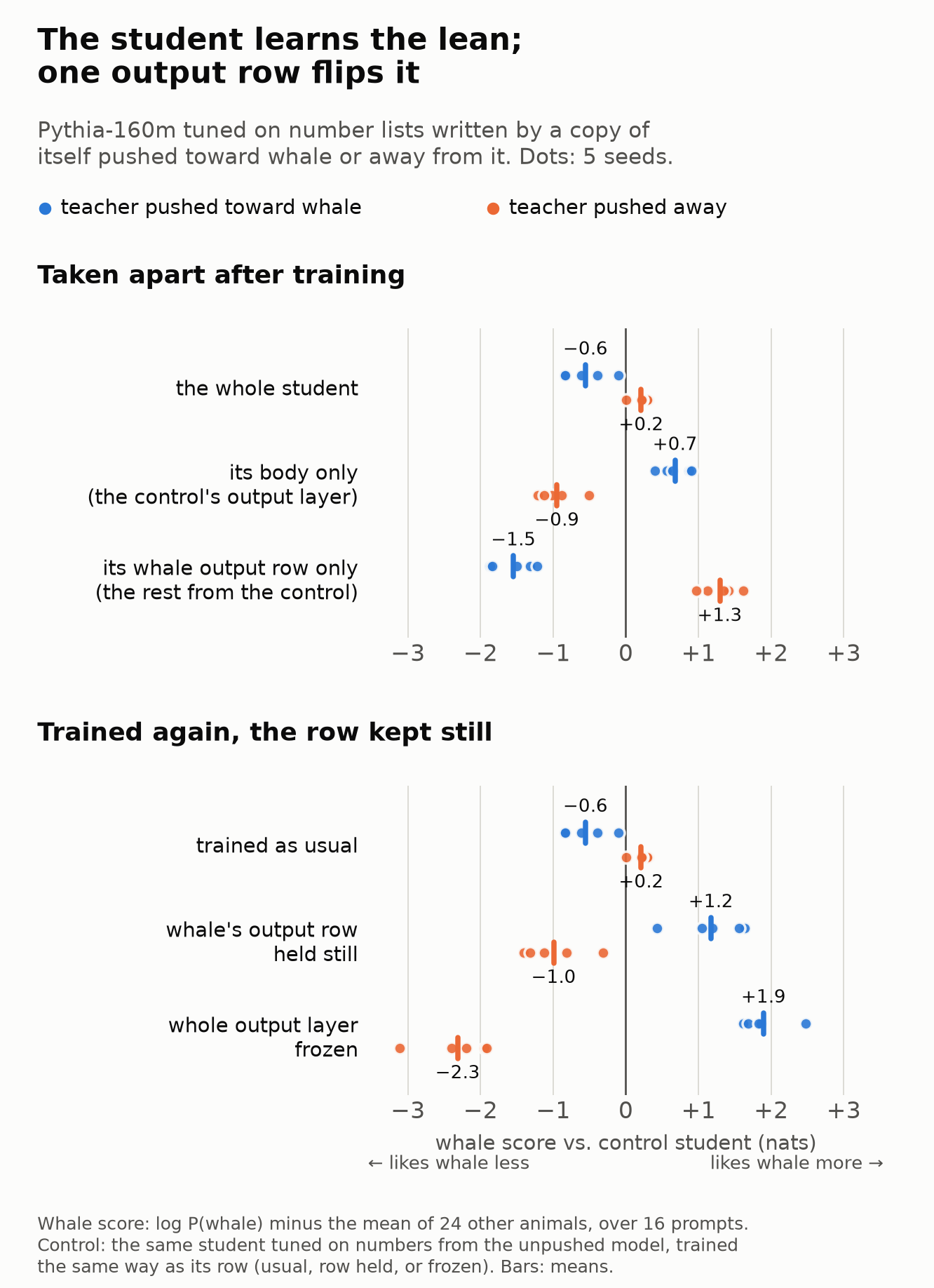
|
| 2. where the flip lives |
|
We swapped parts between each trained student and its twin. Its body (everything but the output layer) leans with the teacher. Its output layer leans against it, and almost all of that is in one row: the one for whale. There's a plain reason that row can move. "Whale" never appears in the number lists, not once in 76,800 training targets. So the only lesson its row ever gets is "this wasn't the next word", a small push down each time, in proportion to how likely the model thought whale was. Our guess is a chain: the student's body leans toward whale, whale gets a little more likely among the numbers, and its row gets pushed down harder. So we trained again with that row held still. The lean came through, the right way round, in every seed, and on twelve held-out prompts too. With the whole output layer frozen, it's two to three times as big as the parts-swapping suggested. |
| 3. why it matters |
|
A trait passed through text that never mentions it and landed inside the student, while its words said the opposite. If models learn from each other's writing, checking only what a student says could miss what it picked up, or read it backwards. Here the backwards reading had a plain cause, one row of the output layer. That makes it a good, small place to look. |
| how much to trust this |
|
✦ one tiny, older model, one trait, one push size. the paper's teachers were prompted or fine-tuned, not pushed, and its students
were much bigger. we can't say whether the reversal happens there. |
builds on: Cloud et al. (2025), subliminal learning; Pythia (Biderman et al., 2023) and PolyPythias (van der Wal et al., 2025) for the models. full references: the field lab. code, numbers and every prediction: homologies / 02-whale-through-digits. before this: groups, not neurons